In short
The core difference is training: a service dog is individually trained to perform a task tied to its handler's disability, while an ESA helps by its presence and needs no training. That decides access. Under the ADA a service dog may enter shops and restaurants and flies in the cabin free; an ESA has no public-access right and flies as a pet. In housing, the Fair Housing Act protects both, and an ESA letter is enough.
If you’re deciding between an emotional support animal and a psychiatric service dog, the distinction comes down to training, access, and paperwork. The two categories get confused constantly, partly because both can be dogs, both can help with a qualifying condition, and both are legally protected, but the protections are not the same, and using the wrong term with a landlord, an airline, or a business can cost you the accommodation you’re entitled to. Here are the seven differences that actually change what you can do with each animal.
1. Do ESAs and service dogs need training?
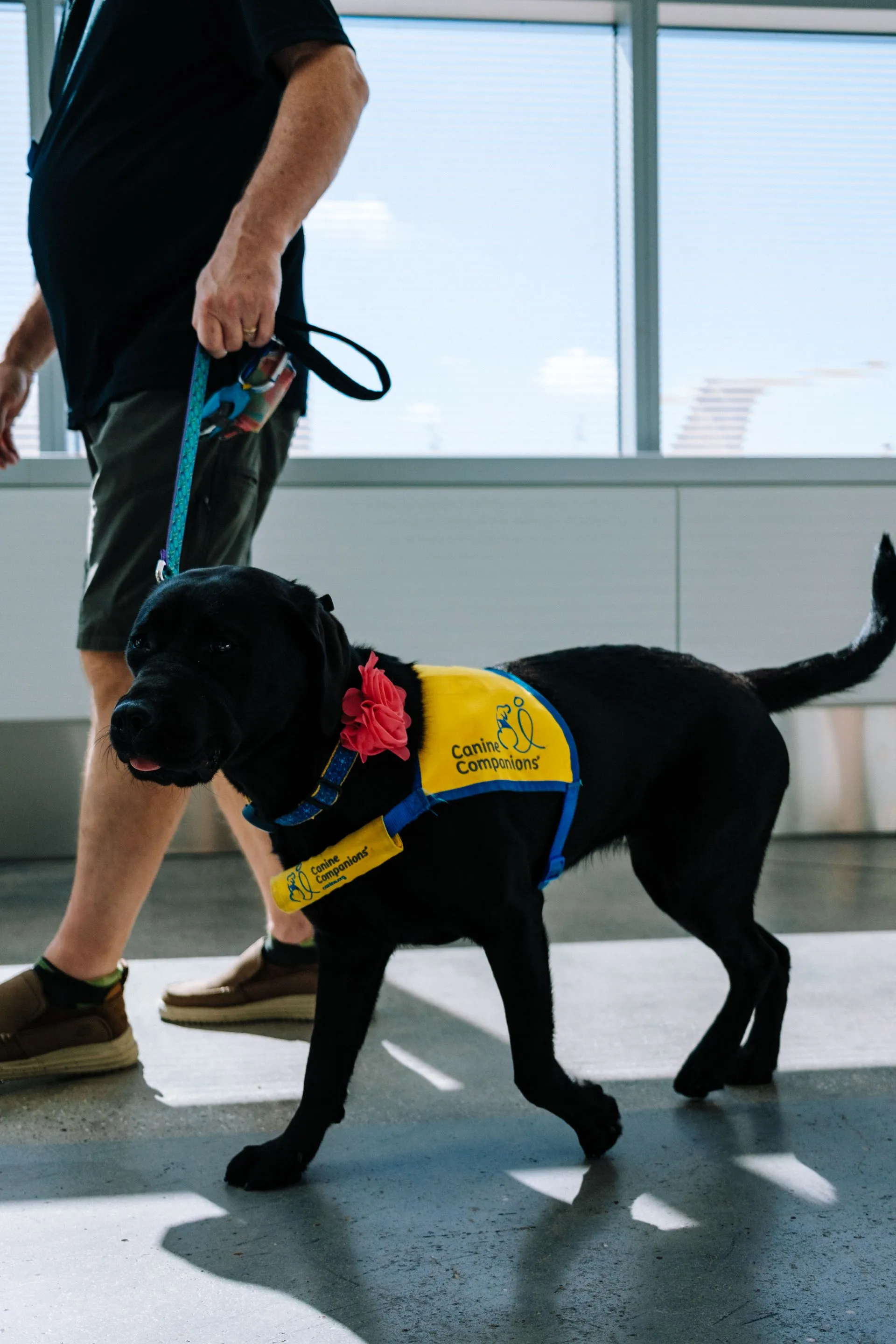
A service dog must be individually trained to perform a specific task that mitigates its handler’s disability. For a psychiatric service dog, that might mean interrupting a panic attack, reminding a handler to take medication, applying deep pressure therapy during a dissociative episode, or guiding a disoriented handler to an exit. The task is the legal threshold: under the Americans with Disabilities Act, a dog that merely provides comfort by its presence does not qualify as a service animal, no matter how well-behaved it is.
An emotional support animal has no task-training requirement at all. Its benefit comes from companionship and the calming effect of its presence, not from performing a learned action. This is why an ESA can be a cat, a rabbit, a bird, or nearly any domesticated animal, while service animal status under the ADA is limited to dogs (and, in limited circumstances, miniature horses). Training is the single biggest legal line between the two categories, and it’s the one most online sellers gloss over.
A common misconception is that a vest, a patch, or an online “certificate” turns a dog into a service dog. None of those items carry legal weight under the ADA. What matters is whether the dog has actually been trained to perform a specific task tied to the handler’s disability. A vest is just fabric if the dog hasn’t learned the task. Conversely, a legitimate psychiatric service dog doesn’t need a vest at all to be protected; businesses are only allowed to ask the two permitted questions, not to demand proof of training.
2. Can an ESA go everywhere a service dog can?
A trained service dog has the right to accompany its handler almost anywhere the public can go (restaurants, grocery stores, hospitals, airplanes, government buildings, and public transit), under the ADA. Staff can ask only two questions: whether the dog is a service animal required because of a disability, and what task it is trained to perform. They cannot ask for documentation, ask about the handler’s diagnosis, or require a demonstration.
Emotional support animals have no such right. A restaurant, retail store, or hotel can legally refuse entry to an ESA, because the ADA’s public access provisions simply don’t extend to animals that haven’t been task-trained. An ESA letter is a housing and, in some cases, a workplace accommodation document. It is not a passport into stores or restaurants, and presenting one to a business that has already said no won’t change the outcome.
This is also where state laws vary the most for service dogs. Some states extend public access rights to service dogs in training, or add penalties for misrepresenting a pet as a service animal; none of that changes the ESA side of the comparison, since ESAs were never covered by public access law in the first place. If public access to everyday businesses is the need driving your decision, only a task-trained service dog meets it, no letter, certificate, or vest changes that for an ESA.
3. Can an ESA fly in the cabin like a service dog?
This is the difference that changed the most recently. Until 2021, US airlines were required to let emotional support animals fly in the cabin for free, often with minimal paperwork. The Department of Transportation revised that rule in 2021, and today airlines are allowed to treat ESAs exactly like ordinary pets: meaning a pet fee, a size or carrier requirement, and no guaranteed seat next to the handler.
Psychiatric service dogs kept their flying rights. Airlines still must allow a trained service dog to fly in the cabin at no charge, though they can require the DOT’s standard service animal air transportation form confirming the dog’s training and behavior. If air travel is a priority, this is the difference that matters most: an ESA letter will not get an animal a free cabin seat in 2026, but valid service dog documentation still will.
4. Do ESAs and service dogs get the same housing protections?
Here the two categories converge. Under the Fair Housing Act, both emotional support animals and service dogs are treated as assistance animals entitled to reasonable accommodation in housing, regardless of a building’s no-pets policy. A landlord cannot charge pet rent, a pet deposit, or breed and weight fees for either type of animal once appropriate documentation has been provided, and a landlord can only deny the accommodation in narrow cases, a direct threat to safety or a building-specific undue burden.
This is why, for housing purposes alone, there’s no advantage to a service dog over an ESA. A qualifying disability plus a letter from a licensed professional is enough to secure the same housing rights a trained service dog would have. Renters sometimes assume they need the “stronger” category to keep their apartment. They don’t.
A landlord also cannot charge a pet deposit, pet rent, or apply a breed or weight restriction to either an ESA or a service dog, and both remain subject to the same narrow exceptions: a documented safety threat or substantial property damage. The practical difference shows up outside the building, not inside the lease.
5. What documentation does an ESA or a service dog need?
An ESA is established through a letter from a licensed provider confirming a disability-related need for the animal’s companionship. Some states add extra requirements: California’s AB 468, for example, requires the letter-writer to have a 30-day client relationship and a completed clinical evaluation before signing.
A service dog requires no certificate, registration, or letter at all under the ADA, businesses aren’t allowed to demand paperwork, only ask the two permitted questions above. That surprises people who expect a service dog to need “official” documentation; legally, the training and the task are what matter, not a certificate. Airlines are the one context where a specific DOT form is required for service dogs, separate from the general ADA rule.
6. Which species can be an ESA or a service animal?
Emotional support animals can be almost any domesticated animal capable of providing comfort: dogs, cats, small mammals, and birds are all common, since there’s no task-training bar to clear. Service animals under the ADA are limited to dogs, with a narrow additional allowance for trained miniature horses in specific circumstances. A pig, a snake, or a rabbit cannot be a service animal under federal law no matter how well trained it is, but any of them could qualify as an ESA if a licensed professional confirms the need.
7. What does an ESA cost compared with a service dog?
Getting an ESA letter is typically a faster, lower-cost process: an evaluation with a licensed professional (subject to state rules like California’s 30-day requirement) resulting in a signed letter, with no animal training involved. Getting a legitimate psychiatric service dog usually means months to years of individualized training, either self-taught with a qualified trainer or through a program, since the ADA requires actual task performance rather than a document.
That cost and time difference is exactly why so many online sellers push one-size-fits-all “registration” packages that promise instant service dog status. No such registry exists, and no certificate substitutes for real task training. If your need is genuinely for task-based intervention, budget for training time; if companionship is what helps, an ESA letter is the appropriate and much faster path.
Cost also scales differently after the initial process. An ESA letter is typically a one-time or annually renewed cost tied to the evaluation itself. A trained service dog carries ongoing costs: refresher training, veterinary care suited to a working animal, and, for program-trained dogs, a placement fee that can run into the thousands of dollars. Neither path is inherently better; they’re priced around genuinely different amounts of professional work.
Which one do you actually need?
If your disability requires an animal to perform a specific trained task: interrupting a panic attack, retrieving medication, providing tactile grounding on command. You need a service dog, and that means investing in real training, not a certificate. If what helps is the animal’s presence and companionship, an ESA letter from a licensed professional is the appropriate, faster, and equally strong option for housing. The two are not a hierarchy; they’re built for different needs, and matching the category to your actual disability-related need is what keeps your documentation legitimate and your rights enforceable.
Frequently Asked Questions
Can an ESA become a service dog?
Yes, if it is individually trained to perform tasks that mitigate a disability. The animal's function, not a certificate, is what makes it a service dog under the ADA.
Do airlines accept emotional support animals?
No. Since the DOT's 2021 rule change, US airlines treat ESAs as pets. Psychiatric service dogs still fly free in the cabin with DOT forms.
Which one do I need for housing?
Both ESAs and service dogs are protected equally in housing under the Fair Housing Act. For housing rights alone, an ESA letter is sufficient.
Share this guide
Support Animal Editorial Team
Reviewed by licensed providers
The Support Animal editorial team researches ESA and PSA regulations nationwide. Every guide is fact-checked against federal and state law and reviewed by licensed providers before publication.